

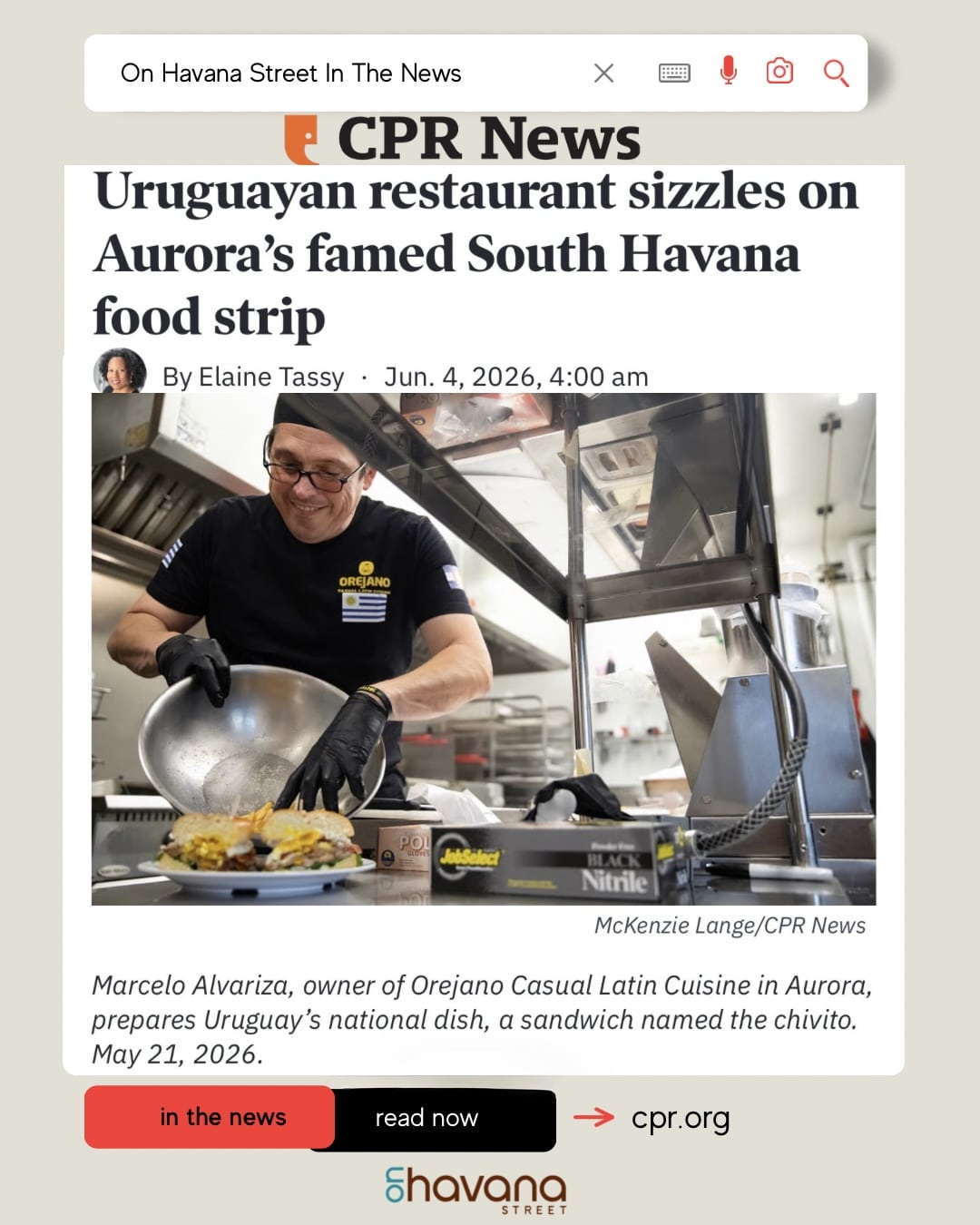



McKenzie Lange/CPR News
The signature sandwich at Marcelo Alvariza’s Uruguayan restaurant, Orejano, is the Chivito Uruguayo. It’s like a ham and egg sandwich, a BLT and a Philly cheesesteak rolled into one, served on a bun.
To make it, Alvariza goes into the kitchen to find what he needs from the fridge: mozzarella cheese, tomato, lettuce, some pre-caramelized onions. Then he grabs a few different meats. On a large grill, he tosses a piece of tenderloin steak that quickly starts to sizzle. He puts a raw egg into a ring on the grill, and simultaneously fries a few bacon strips and a slice of ham. Sounds of sizzling and bubbling can be heard in his solo kitchen.
Then he uses a knife to cut a piece of romaine lettuce into a circle, the same size as the bun.
“If it’s all loose, I don’t like how it looks,” he said of the lettuce, never one to ignore these little details.
His is one of the newest restaurants among about 100 on South Havana Street in Aurora. The 4.3 mile strip, known as “On Havana Street,” features some chains like Wendy’s and Jersey Mike’s, but, located between East Dartmouth and East Sixth streets, it is known for featuring cuisine from countries with world-renowned gastronomy: Italy, India, Korea, China and Ethiopia. It also has eateries from countries with smaller populations and even smaller culinary footprints including Armenia, Turkey, and El Salvador.
Orejano – according to Alvariza, his mom, and Google – is the only known Uruguayan restaurant in Colorado, adding to South Havana’s uniqueness with an eatery focusing on Uruguayan empanadas and sandwiches.
The Signature Sandwich

McKenzie Lange/CPR News
Its signature sandwich, the Chivito Uruguayo, is connected to a story most Uruguayans have probably heard. The word “Chivito” means baby lamb, but the sandwich includes proteins from most other animals – none in the lamb or sheep family. That’s because the restaurant owner who created it almost 80 years ago didn’t have any on hand.
According to the tall, affable, chatty Alvariza, the history of the sandwich is as specific as its flavor: One night in 1949, a rich and fancy woman from Argentina went to a Uruguayan restaurant that was about to close for the night. It was located in the resort town of Punte de Este on Uruguay’s southeastern coast.
“She was asking for lamb, something with lamb, and he didn’t have any lamb to cook,” he said. “So she said, ‘Well, use what you have, to make me something.’ And he make this sandwich and he say, ‘Here you have chito, your lamb,’ … and it got that popular after that.”
Perhaps it’s a combination of the different meat textures, eaten in one bite, with juice of the egg yolk dripping down, that gives the impression of having the chewier bite of lamb. Now, it’s the most often ordered dish at Orejano, the restaurant that opened in June 2025.
“It is our signature sandwich in Uruguay,” said Alvariza, 46, who lives in Littleton. “That was how it started in Uruguay, and that’s the way everyone knows it. (Back home) we put more things on top, but I don’t want to do it that big,” he said.
| About this series
To discover origin stories, influences, plans, signature dishes and highlights of some lesser-known gastronomic cuisines in the foodie wonderland of Aurora, CPR News spent a few months trolling dozens of restaurants, both on and off South Havana Street, and their menus, to identify a few serving cuisine from smaller countries not commonly known for their gastronomy. Orejano’s is one, and in coming weeks, we will visit a few others whose cuisines are also unique – Aztec Mexican, Haitian, Syrian and Sudanese – to find out more about flavors, ingredients and influences on cuisines from those parts of the world. Each Thursday for the rest of June, we will share stories stemming from these restaurants, most of them small, easy to miss, existing under the radar, with limited promotional budgets, and packed with juicy bites and stories from their respective homes. |
Uruguayan influences
Uruguayan cuisine is like a mash-up of Italian and Spanish, according to Alvariza, whose wife and mother are frequently in the restaurant, which has about 10 tables and a relaxed, casual vibe. He said the spices used – garlic, onion – tend not to be on the hotter side, and that the flavors are similar to Italian.
Alvariza said he makes adjustments to accommodate the demands of his customers, mainly Aurorans – which means they are from all over the world, including some Muslim countries where people only eat Halal meats.
“They were coming and leaving because we didn’t have it,” he said. “So we switch it so we can get in the culture here.”
The taste of Halal meats reminds him of the grass-fed meat he was used to eating in Uruguay, where he lived from the ages of 4 to 23. He was born in the U.S. before returning to Uruguay, and then traveled back and forth as he grew up. “It’s a little stronger, but the way that I grew up and I love it … we do it all Halal because yes, a lot of our customers, they only eat Halal meat.”
During a recent visit, his wife, Maria Griselda Aguero, who is from Paraguay, was at the front cash register serving customers with take-out or dine-in orders, while his mother, Elizabeth Suarez, sat at a vacant dining table, after having stocked the glass-door fridge with Uruguayan desserts she made herself, including flan with caramel sauce and chaja, a cake served in a circular shape, similar to the Mexican tres leches cake, but stuffed with sliced peaches.
Alvariza took visitors for a tour of the kitchen, where the restaurant’s sandwiches and empanadas are made, while explaining how he became the owner of this new eatery and how he plans to scale it up.

McKenzie Lange/CPR News
How the restaurant started

McKenzie Lange/CPR News
While sounds of various non-lamb meats sizzled, Alvariza said he’d been working with his older brother in construction, specializing in flooring, doing ceramic tiles. He didn’t like the work, because when it was time for him to lay tiles, he needed other contractors to clear out. But they’d still be wrapping up the electric wiring, window installation or wall details, getting in his way, stepping on his freshly laid tiles and planks. People didn’t get along; everyone was having conflict.
He’d enjoyed cooking since he was a child. As his mother explained: “He really likes to cook. All of my kids, everyone has something they like better, but he was constantly with cooking for everybody and trying new styles and everything.”
He and his father had a shared dream to open a restaurant featuring Uruguayan food. He thought he’d move back to Uruguay to do it — it was always in the back of his mind. But his father died from a heart attack in 2009. So, frustrated with the life of a construction worker and now without his prospective partner, he kept the dream in his heart.
Then he had a pivotal moment: one day, he started to feel a tightness in his throat, and he felt weak. He called his wife and 911 at the same time. The ambulance got there before his wife did, and when paramedics got him to the hospital, they told him he almost didn’t make it. When he learned in the ER that he was just minutes from a massive stroke, he decided it was time to stop just talking and thinking about changing careers — and do it.
The space he found was once a Chinese restaurant along the well-known restaurant strip. He decided to rent it and give restauranting a whirl. “It was my first time ever in restaurant, but thank God we growing little by little,” he said.
Now, he only does tile work when his brother goes on vacation, and he spends most of the time at the restaurant, describing the yellow-painted modern space as his happy place. When asked his favorite part about running it, he said, “Being here all day. Honestly. Being talking with people, cooking in the back, it’s not a stress, like in construction. I can be all day and not feel like any stress or work,” he said.
The Cuisine

McKenzie Lange/CPR News
The cuisine he serves is representative of the country he’s from: the second smallest in South America, bigger than only Suriname. Its population, about 3.5 million people, is heavily comprised of Spanish and Italian immigrants who’d fled their home countries because of internal conflicts and settled in Uruguay, which, like neighboring Argentina, welcomed them.
According to his mother, Italian influences were within their own family — they came from his paternal grandmother. Of her son, she said, “He used to be next to my husband, who enjoys cooking, trying to learn everything … and my mother-in-law that was Italian, and she has everything homemade.”
His Nonna wasn’t doing all the cooking alone. “Sundays we were waking up at 7:30 in the morning and she started making the sauce, the tomato sauce,” Alvariza said in his usual jovial manner. “We would make all the pastas all from scratch doing all. … lunch was a big ceremony, so we were cooking for five, six hours.” Then his aunts and uncles and cousins would come over. “On Sundays we were like 30, 40 people … together almost every single weekend.”
How things are working now
After cooking the chivito sandwich, and watching with enthusiasm as his two CPR journalist guests sampled it, wiping meat and egg juices from the super-thick sandwiches, Alvariza sat down at the table beside his mother, who lives a few blocks from him and no longer drives. He picks her up a few days a week and brings her to the restaurant so she can socialize and stock the desserts.

McKenzie Lange/CPR News
He wanted to find a space in the fast-casual cuisine scene, but wasn’t sure how well people would respond to the foods he wanted to serve, so as he was transitioning out of construction, he used his former colleagues as taste-testers.
“When I was in construction, every time we close a project, or we were having a meeting with my customer to see a new project, I always brought empanadas to them. So I was giving them different flavors to see which one they wanted, you know, which one the people like more.”
That led him to tweak some of his selections, adding in some Thai flavors and Mexican spices to give the empanadas some variety he might not have thought of. Based on the feedback he got, he decided to do about half traditional Uruguayan fillings, and half “more multi-cultural flavor,” including Mexican and Thai fillings.
He bakes, rather than fries, the empanadas, so they’re healthier and easier to prepare in bulk, and finishes them by stamping them with vegetable ink so they’re branded with the type of filling hidden inside.
Still, he’s trying to determine if he’s using the right amount of sauces and spices, whether anything needs improvement. “My wife always tell me, ‘Oh no, that’s good already. Don’t keep trying,’ but until I feel like it’s the way I want, I keep trying, keep doing it.”
He’s finally fixed on 18 different empanadas on the English/Spanish menu, including sweet corn, spinach, spicy mushroom, sausage, blue cheese, lamb, bacon and egg, and several varieties of beef. He also features a handful of sandwiches, including the lamb-not-lamb chivito, and a Milanese sandwich made with chicken or eggplant.
His mother said her youngest of four is finally living out his dream: “I think that he has a lot of passion. What he’s doing, he tries to improve and change and he really enjoys when the end is what he wants.”